Compress PDF for Oracle Fusion Cloud ERP: Keep Invoices, Receipts, and Approval Backup Small Without Losing Review Clarity
To compress a PDF for Oracle Fusion Cloud ERP, upload the file to LifetimePDF's Compress PDF tool, start with Medium compression, and keep the smaller copy only if supplier names, invoice numbers, tax amounts, totals, and approval details still read cleanly.
For most Oracle Fusion Cloud ERP workflows, under 2MB is a strong target for text-heavy invoices and standard support PDFs, while scan-heavy receipt bundles, journal support packets, and approval backup usually fit best around 2MB to 5MB.
Oracle Fusion Cloud ERP attachments get heavy in a very ordinary way. One invoice PDF is clean. Then someone appends a receipt packet, approval screenshots, a statement page, and journal support that got scanned twice. The file is not more useful. It is just heavier to upload, slower to review, and more annoying to reopen during close or audit follow-up. Good compression fixes that without making the evidence feel flimsy.
Fastest path: use LifetimePDF's Compress PDF tool at Medium, then use OCR, page cleanup, or splitting only if the packet is still heavier than the next reviewer actually needs.
Need the short version? Jump to Quick start: compress an Oracle Fusion Cloud ERP PDF in about 2 minutes.
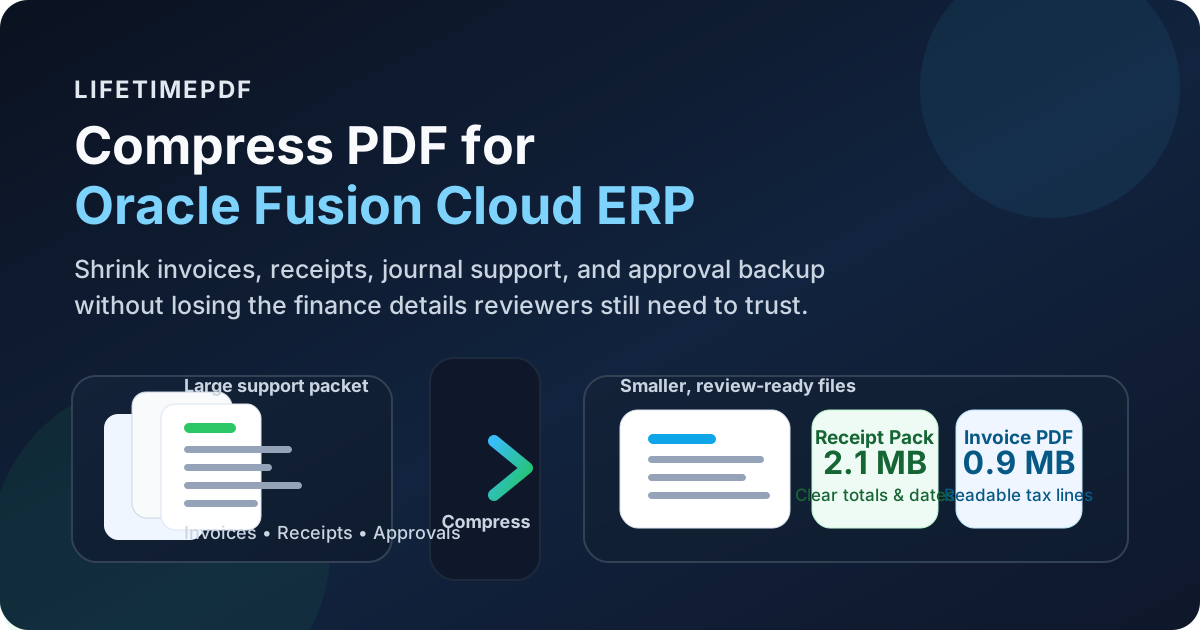
Table of contents
- Quick start: compress an Oracle Fusion Cloud ERP PDF in about 2 minutes
- Why smaller PDFs help in Oracle Fusion Cloud ERP workflows
- What size should an Oracle Fusion Cloud ERP PDF be?
- Which compression level should you choose?
- Step-by-step: shrink a PDF with LifetimePDF
- Best approach for common Oracle Fusion Cloud ERP document types
- What to do if the PDF is still too large
- How to keep finance details readable
- Workflow habits that prevent PDF bloat
- Related LifetimePDF tools and useful reading
- FAQ (People Also Ask)
Quick start: compress an Oracle Fusion Cloud ERP PDF in about 2 minutes
If your real goal is simply make this Oracle Fusion Cloud ERP PDF smaller so it is easier to upload, review, or archive, this workflow is usually enough:
- Start with the supplier invoice, receipt packet, statement page, journal support file, or approval backup you actually plan to keep.
- Open Compress PDF.
- Choose Medium compression first.
- Download the smaller file and compare the size reduction.
- Check the fragile details once: supplier names, invoice numbers, dates, tax amounts, line items, totals, account strings, and approval comments.
- If the packet is still bulky, use OCR PDF, Delete Pages, Crop PDF, or Split PDF before trying stronger compression.
Why smaller PDFs help in Oracle Fusion Cloud ERP workflows
Oracle Fusion Cloud ERP is where PDF clutter stops being theoretical. The attachment is what someone actually opens when they need to confirm the supplier, compare the invoice number, match the receipt, review an approval trail, or trace support during month-end close. When that file is oversized, every ordinary task becomes slower than it should be.
Smaller PDFs reduce friction at each handoff. They upload more smoothly, open faster on ordinary laptops, and make it easier for the next reviewer to focus on the transaction rather than the file. The useful goal is not the smallest file possible. It is the smallest file that still preserves the proof.
Why compression usually pays off
- Faster uploads: useful when invoices and support need to move through approval or accounting queues without delay.
- Smoother review: lighter PDFs are easier to open during AP checks, close work, supplier follow-up, and audit prep.
- Less scan waste: phone captures and rescans often carry shadows, empty borders, and blank backs that add nothing useful.
- Cleaner records: smaller files are easier to archive, resend, and retrieve later.
- Better downstream cleanup: leaner PDFs are easier to OCR, split, crop, extract from, or convert once the file is under control.
What size should an Oracle Fusion Cloud ERP PDF be?
There is no single magic number for every Oracle Fusion Cloud ERP workflow, but practical target ranges keep you from compressing harder than necessary:
| Document type | Good target range | What to protect |
|---|---|---|
| Supplier invoices, clean statement pages, standard support PDFs | About 0.5MB to 2MB | Supplier names, invoice numbers, dates, tax lines, totals, and account references |
| Receipt bundles, approval backup, mixed support packets | About 1MB to 3MB | Merchant names, dates, totals, small notes, and screenshot callouts |
| Journal support, receiving paperwork, scan-heavy close packets | About 2MB to 5MB | Line-item tables, faint scans, signatures, stamps, and explanatory notes |
| Anything above 5MB | Usually needs cleanup first | At that size, duplicate pages, empty scan borders, or unnecessary appendix content are often the real problem |
The right range depends on what the next reader truly needs. If the file exists to prove a total, a date, a supplier, a coding decision, or an approval, protect those details first. The goal is not to chase a dramatic percentage reduction. The goal is to make routine finance evidence easier to work with.
Which compression level should you choose?
The most common mistake is jumping straight to the strongest setting because the file looks annoyingly large. That is how you turn clear invoice support into soft tables and weak receipt text. For most Oracle Fusion Cloud ERP PDFs, a measured order works better:
- Low compression: useful when the PDF is already fairly clean and only needs a light trim.
- Medium compression: the best default for most invoices, approval packets, journal support, and mixed finance PDFs.
- High compression: use this only after removing duplicate pages, cropping scan waste, or splitting an oversized packet.
Step-by-step: shrink a PDF with LifetimePDF
- Save the final working copy first. Use the file you actually plan to attach or archive, not an early draft with pages you already know nobody needs.
- Open Compress PDF.
- Upload the file. This could be an invoice PDF, receipt bundle, journal support packet, receiving document, statement page, or approval backup.
- Start with Medium compression. It is usually the safest first pass for finance-support files.
- Download the smaller result. Check the new size and decide whether it already feels easier to handle.
- Preview the weak spots. Look at line items, supplier names, dates, tax lines, totals, approval notes, and any faint scan detail.
- Use OCR or structure fixes only if needed. If the file is still too heavy, run OCR PDF, remove duplicate pages, extract only the needed section, or split the appendix before trying a stronger setting.
Useful sequence: compress first, then clean the packet structure. In finance workflows, the oversized file is often carrying too much baggage, not too little compression.
Best approach for common Oracle Fusion Cloud ERP document types
1. Supplier invoices and AP support
These usually compress well because the most important information is text-based. Medium compression is often enough. The risk is not losing the logo or the decorative parts. The risk is softening the invoice number, due date, tax lines, remit details, or final total just enough to slow the next review.
2. Receipt bundles and expense support
Receipt packets get bulky fast because they often mix phone captures, screenshots, thermal-paper text, and summary pages. If the bundle still feels huge after one pass, the fix is often cleanup rather than harder compression. Remove blank backs, crop dead space, and keep only the pages the reviewer actually needs.
3. Journal support and close packets
These files can become dense because they combine account support, statement excerpts, backup schedules, and notes for later follow-up. When one PDF tries to carry every possible piece of support forever, it becomes harder to review in the present. Compress once, then split the summary from the appendix if the packet still feels bloated.
4. Approval backup and receiving paperwork
Approval evidence and receiving documents often include stamps, signatures, screenshots, and already-weak scans. Protect the tiny details first. If the confirmation text or receiving reference becomes mushy, the file stopped doing its job even if the size number looks better.
5. Mixed finance packets
Some attachments are simply a little of everything: invoice PDF, statement page, receipt images, and an approval screenshot. In those cases, do not assume one aggressive setting will solve it. Compress once, review the weakest page, then decide whether the better move is OCR, extraction, or splitting rather than more compression.
What to do if the PDF is still too large
When an Oracle Fusion Cloud ERP PDF stays heavy after one reasonable compression pass, the issue is often packaging rather than image density. Try these in order:
- Delete repeated or blank pages. This solves more than people expect in accounting support packets.
- Extract only the pages the next reviewer needs. A focused six-page packet usually works better than a thirty-page archive dump.
- Split the appendix. Keep the main support in one PDF and the backup evidence in another.
- Crop empty borders and background. Scan waste adds size without adding proof.
- Run OCR on image-only paperwork. Searchability matters long after the first upload.
- Only then try stronger compression. By that point, the file is usually leaner already.
How to keep finance details readable
Before you keep the compressed copy, check the weakest details on the page rather than the strongest ones. Headings almost always survive. The useful details are what quietly fail.
- Supplier names and remit details: confirm they are still crisp.
- Invoice numbers and dates: especially on scans and exported statement excerpts.
- Tax lines, subtotals, and totals: numbers should still read cleanly without guesswork.
- Line-item tables and coding notes: zoom in on the densest sections once.
- Approval comments or references: these are easy to lose when the original screenshot or scan was weak.
- Handwritten marks, stamps, or signatures: protect them if they matter to validation later.
A 20-second review saves far more time than rebuilding the packet later because somebody could not read one number or one note that mattered.
Workflow habits that prevent PDF bloat
- Export once from the cleanest source available. Reprinting and rescanning usually adds size without adding value.
- Trim before you merge. It is easier to keep one support packet clean than to repair a giant combined PDF later.
- Separate summary from appendix. Not every reader needs every page.
- Use OCR on paper-origin files. Searchable PDFs age better in finance archives.
- Review one sample page before forwarding everything onward. Catching blur early is cheaper than resending a packet later.
Related LifetimePDF tools and useful reading
Oracle Fusion Cloud ERP document prep often turns into a few follow-on tasks. These tools usually pair well with compression:
- Compress PDF for the first size-reduction pass.
- OCR PDF for scanned invoices, receipts, and support documents.
- Extract Pages when only part of the packet needs to travel.
- Delete Pages to remove duplicate or blank support pages.
- Split PDF when one packet is doing two jobs at once.
- Crop PDF to trim dead scan borders.
If you want adjacent reading, these guides fit the same workflow family: Compress PDF for Oracle Fusion Cloud ERP Without Monthly Fees, Compress PDF for Oracle Fusion Cloud ERP: Upload Smaller Invoices, Receipts, and Supporting Documents Faster, Compress PDF for Dynamics 365 Finance Without Monthly Fees, and Compress PDF for NetSuite.
Bottom line: if the Oracle Fusion Cloud ERP PDF is too large, start with Medium compression, protect the finance details that matter, and clean the packet structure before you force the file any harder.
FAQ (People Also Ask)
How do I compress a PDF for Oracle Fusion Cloud ERP?
Upload the Oracle Fusion Cloud ERP-ready PDF to a PDF compressor, start with Medium compression, and keep the smaller copy only after checking supplier names, invoice numbers, dates, totals, tax amounts, and approval details. For most finance-support PDFs, Medium is the safest starting point because it reduces file size without weakening review clarity.
What file size should I aim for with Oracle Fusion Cloud ERP PDFs?
Text-heavy invoices, statement pages, and standard support files usually work well under 2MB. Receipt bundles, journal support packets, and scan-heavy approval backup often land better around 2MB to 5MB as long as the smallest useful details remain easy to read.
Will compression make invoice numbers or tax amounts blurry?
It can if you compress too aggressively. That is why Medium compression is usually the best first move. Always review invoice numbers, dates, tax amounts, totals, coding strings, and approval notes before you keep the smaller file.
Should I run OCR on scanned Oracle Fusion Cloud ERP attachments?
Usually yes if the PDF came from a scanner or phone camera and the text is not selectable. OCR makes finance PDFs easier to search, validate, and reuse later during approvals, close work, supplier follow-up, and audit checks.
What if the PDF is still too large after compression?
Delete duplicate pages, crop empty scan borders, split one oversized packet into summary and appendix files, or extract only the pages the next reviewer actually needs. In many Oracle Fusion Cloud ERP workflows, better packet structure helps more than stronger compression.