Compress PDF for Local Falcon: Shrink Geo Grid Reports, Map Pack Snapshots, and Client PDFs Without Losing Clarity
To compress a PDF for Local Falcon, export or print the report as PDF, upload it to LifetimePDF's Compress PDF tool, start with Medium compression, and keep the smaller copy only if grid labels, ranking numbers, map details, and notes still look clean.
For most Local Falcon PDFs, under 2MB works well for a short single-location scan or focused client update, while multi-location geo grid reports, screenshot-heavy comparisons, and broader reporting packs usually sit best around 2MB to 5MB.
Local Falcon PDFs are usually the handoff layer of local SEO work. The report leaves the platform and needs to make sense to a client, franchise owner, account manager, or teammate who mostly wants the useful part fast. That is why smart compression matters. You are not trying to crush the file into the tiniest possible download. You are trying to make it easier to email, upload, archive, and review without softening the grid cells, map labels, screenshots, or next-step notes that make the report trustworthy.
Fastest path: run the Local Falcon export through LifetimePDF's Compress PDF tool on Medium, then do one quick readability check before you send, upload, or archive the smaller copy.
Short on time? Jump to Quick start: compress a Local Falcon PDF in under 2 minutes.
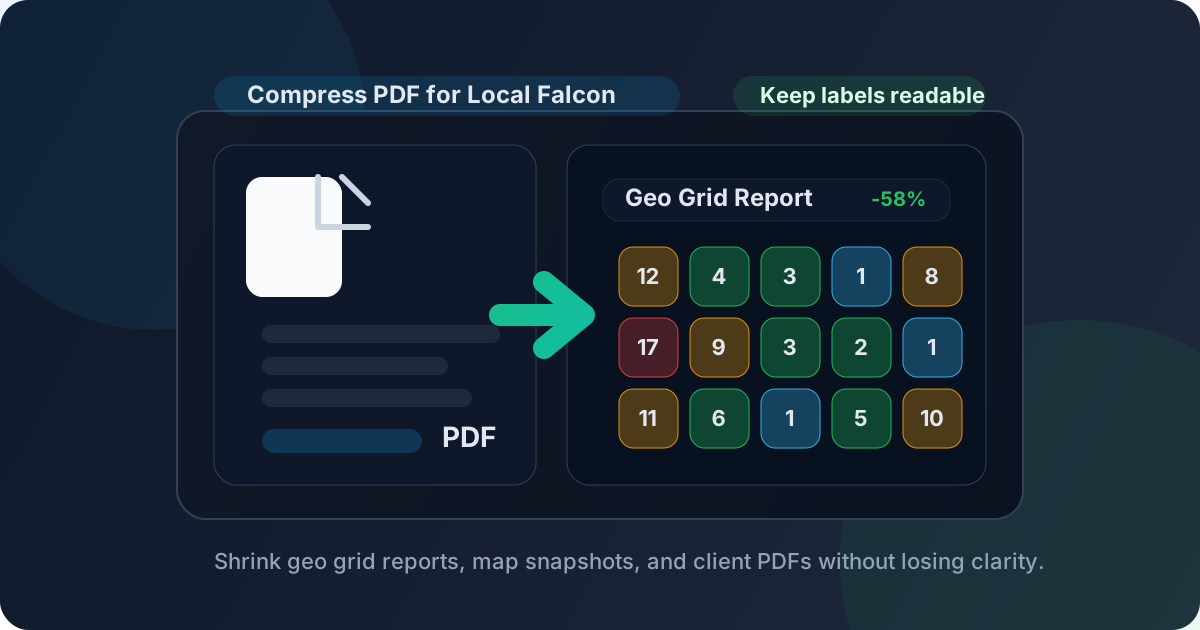
Table of contents
- Quick start: compress a Local Falcon PDF in under 2 minutes
- Why smaller PDFs help in Local Falcon workflows
- What file size should you aim for?
- Which compression level should you choose?
- Step-by-step: shrink a Local Falcon PDF with LifetimePDF
- Best strategy for common Local Falcon PDF types
- What if the PDF is still too large?
- How to keep geo grids, screenshots, and notes readable
- Workflow habits that reduce PDF bloat
- Related LifetimePDF tools and internal links
- FAQ (People Also Ask)
Quick start: compress a Local Falcon PDF in under 2 minutes
If your real goal is simply make this Local Falcon PDF smaller so it is easier to send, review, and store, this workflow is usually enough:
- Open Compress PDF.
- Upload the Local Falcon PDF you want to shrink, such as a geo grid report, map pack snapshot, ranking scan, before-and-after comparison, or client-ready recap.
- Choose Medium compression first.
- Download the smaller file and compare the new size with the original.
- Open it once and check the smallest useful details: grid labels, ranking numbers, legends, dates, screenshot callouts, and summary notes.
- If the report is long, use Split PDF or Extract Pages to keep only what the next reader needs.
- If the file is still heavy, trim repeated screenshots, duplicate appendix pages, or oversized map captures before you try a stronger compression level.
Why smaller PDFs help in Local Falcon workflows
Local Falcon reports are useful because they turn local visibility into something people can share. A geo grid can show where rankings hold up. A map pack snapshot can show where visibility drops. A before-and-after scan can make progress obvious without needing a live demo. But once that work becomes a PDF, the file itself can start getting in the way.
Heavy PDFs slow down simple tasks. They feel awkward in email, clunky in client portals, and annoying to open on mobile when somebody only needs the main takeaway. In practice, the extra weight usually comes from screenshot-heavy pages, repeated location sections, wide map captures, or one oversized report that is trying to answer every possible follow-up in a single file. Good compression removes some of that friction without weakening the evidence.
Why compression usually helps
- Faster sharing: smaller files are easier to email, upload to client portals, and send through chat threads.
- Smoother review: a lighter PDF opens faster when someone only needs the local ranking story before a meeting.
- Cleaner archives: recurring local SEO reporting is easier to store when every monthly pack is not bloated.
- Better client handoffs: people are more likely to open and read a focused compact PDF than a bulky attachment.
- Less rework: one good compression pass is usually easier than rebuilding and resending an overstuffed report.
What file size should you aim for?
There is no single perfect number for every Local Falcon export, but a few practical ranges keep you from compressing harder than necessary:
| Local Falcon PDF type | Useful target range | Why this range works |
|---|---|---|
| Single-location ranking snapshot or short client update | Under 2MB | Usually small enough for easy email and quick review while keeping grid labels and ranking cells clear. |
| Before-and-after comparison scan | 1MB to 3MB | Good for lightweight sharing when the main value is the comparison, not a large appendix. |
| Multi-location geo grid recap | 2MB to 4MB | Allows room for more screenshots, legends, and location sections without over-compressing them. |
| Screenshot-heavy client pack | 3MB to 5MB | More realistic when the report relies on visual proof, annotations, and side-by-side examples. |
If your file is far above those ranges, the best fix is not always stronger compression. Sometimes the better answer is sending less PDF. A decision-ready summary and a full appendix do not always need to live in the same document.
Which compression level should you choose?
Most Local Falcon PDFs respond well to a conservative first pass. The main goal is keeping geo grid labels, screenshot callouts, legend text, and notes readable while cutting file size enough to make sharing easier.
Low compression
Use this when the file already looks clean and you only need a modest reduction. It is a good choice for detail-heavy scans where map labels and fine screenshot text matter more than squeezing out every last megabyte.
Medium compression
This is usually the best default for Local Falcon. It often lowers size enough for practical sharing while preserving the details that matter: grid cells, ranking numbers, map labels, color-coded patterns, screenshot evidence, and summary notes.
High compression
Save this for files that are still too large after you have already trimmed obvious waste. High compression can be helpful, but it is more likely to soften smaller text or make screenshots feel less reliable. Use it last, not first.
Step-by-step: shrink a Local Falcon PDF with LifetimePDF
- Export the right version first. If the report includes extra pages that the next reader does not need, remove those before you start.
- Open Compress PDF.
- Upload the file. This might be a geo grid report, map pack snapshot, ranking comparison, location recap, or a broader client pack.
- Start with Medium compression. This is usually the safest first pass.
- Download the smaller copy. Compare the new size to the original so you know whether the reduction was meaningful.
- Do a fast readability check. Open the PDF and scan the smallest useful details: grid cells, ranking numbers, map labels, dates, screenshot annotations, and action notes.
- Split or extract if necessary. If the file is still bulky, use Split PDF or Extract Pages instead of automatically pushing compression harder.
That last step matters. Many oversized Local Falcon files are really packaging problems, not compression problems. If one PDF is trying to serve executives, account managers, and location owners at the same time, smaller file size often comes from better separation, not more aggressive compression.
Best strategy for common Local Falcon PDF types
Geo grid reports
These often compress well because much of the value lives in repeated visual blocks and short summaries. Medium compression is usually enough. Just make sure grid labels, ranking positions, and any key commentary still look crisp.
Map pack snapshots
These can be more fragile because small labels and screenshot detail matter. Compress first, then check the smallest annotations before you keep the smaller copy.
Before-and-after comparisons
Comparison-focused PDFs are often heavier because they include two sets of visuals, comments, and proof. Compress first, then split the appendix away from the summary if the pack still feels too broad.
Multi-location client packs
These usually need the most care because they blend visuals, commentary, and proof across several locations. Medium compression is a good start, but it is smart to trim repeated screenshots, old appendix pages, and anything that does not directly support the current reporting period.
What if the PDF is still too large?
If compression alone does not get the file where you want it, the next move is usually structural cleanup:
- Split multi-location sections into separate PDFs.
- Extract only the summary pages for the person who does not need the appendix.
- Remove duplicate screenshots that make the same point twice.
- Trim older pages that were left in the export out of habit.
- Keep the client version focused and save the full working file separately.
In other words, do not ask compression to solve an overpacked report by itself. Often the cleanest result is a smaller, better-targeted PDF rather than a harder-compressed all-in-one file.
How to keep geo grids, screenshots, and notes readable
Before you send the compressed file, scan the parts that matter most in real Local Falcon workflows:
- Grid labels: make sure they still read clearly at normal zoom.
- Ranking cells: check that position numbers and color changes are still easy to follow.
- Map labels: verify that the small geography cues remain usable.
- Screenshot callouts: confirm that captions, arrows, and proof images remain useful.
- Action notes: make sure the next-step recommendations still look clean enough to trust.
Workflow habits that reduce PDF bloat
The easiest megabyte to save is the one you never add. A few habits help keep Local Falcon exports smaller from the start:
- Export only the locations, scan dates, and sections the next reader actually needs.
- Separate executive summaries from location-by-location appendix material.
- Use fewer repetitive screenshots when a short written note says the same thing.
- Keep internal working copies separate from client-facing handoff PDFs.
- Compress once at the end instead of repeatedly saving and resaving the same file.
These habits matter because local SEO reporting tends to grow by accumulation. A cleaner reporting package usually beats a heavier one, even before compression starts.
Related LifetimePDF tools and internal links
Local Falcon exports are usually easier to manage when compression works together with one or two cleanup tools:
- Compress PDF for the first size reduction pass.
- Split PDF for breaking multi-location packs into smaller files.
- Extract Pages for sharing only the summary pages a client or stakeholder needs.
- Delete Pages for removing duplicated proof or stale appendix sections.
- Crop PDF for trimming oversized map captures before another compression pass.
- PDF Metadata Editor if you want a cleaner client-facing file before delivery.
- Compare PDFs when you want to confirm exactly what changed between report versions.
Related reading on LifetimePDF: Compress PDF for Local Falcon Without Monthly Fees, Compress PDF for Local Falcon: Share Smaller Geo Grid Reports, Compress PDF for Google Business Profile, and Compress PDF for Yext if your local SEO workflow overlaps several reporting tools or you want nearby exact-match guides too.
Practical next step: compress the Local Falcon PDF first, then split or extract pages only if the report is still bulkier than the next reader needs.
FAQ (People Also Ask)
How do I compress a PDF for Local Falcon?
Export the Local Falcon report as a PDF, upload it to a PDF compressor, start with Medium compression, and preview the smaller copy before sharing it. Medium compression is usually the safest first pass because it lowers file size while keeping grid labels, ranking numbers, map snapshots, and notes readable.
What file size should I aim for with Local Falcon PDFs?
Under 2MB works well for a short single-location snapshot or focused client update. Multi-location geo grid packs, screenshot-heavy comparisons, and broader reporting bundles usually land best around 2MB to 5MB as long as the smallest useful labels still read clearly.
Will compression make Local Falcon grid labels or screenshots blurry?
It can if you compress too aggressively. That is why Medium compression is usually the best place to start. Always review grid labels, ranking numbers, map labels, screenshot callouts, and summary notes before you keep the smaller file.
Should I split a large Local Falcon PDF instead of compressing it harder?
Often, yes. If one PDF combines several locations, scan dates, screenshots, appendix sections, and different summaries for different readers, splitting it usually works better than forcing stronger compression across the whole document.
Which LifetimePDF tools pair best with Local Falcon exports?
Compress PDF is the main starting point. Split PDF, Extract Pages, Delete Pages, Crop PDF, Compare PDFs, and PDF Metadata Editor are especially useful when you want smaller, cleaner local SEO report packs without sending the whole appendix every time.