Compress PDF for Hunter Campaigns: Keep Cold Outreach Attachments, One-Pagers, and Follow-Up PDFs Easy to Open
To compress a PDF for Hunter Campaigns, upload the final one-pager, case study, proposal, pricing sheet, or follow-up PDF to LifetimePDF's Compress PDF tool, start with Medium compression, and keep the smaller copy only after screenshots, personalization details, pricing, and CTA sections still look clean in the real Hunter Campaigns sequence, follow-up step, or prospect handoff where the file gets reopened.
For most Hunter Campaigns PDFs, under 2MB is a strong target for one-pagers, short proof docs, and simple outreach attachments, while longer proposals, screenshot-heavy decks, and multi-page follow-up packets usually work best around 2MB to 5MB after light cleanup.
Hunter Campaigns works best when outreach feels quick to open and easy to act on. Heavy PDFs get in the way. They make a simple email feel bulkier than it should, they slow mobile review, and they add friction to the exact moment when you want a prospect to skim, understand, and reply. The win is not the tiniest possible file. It is the lightest PDF that still feels sharp, credible, and worth opening.
Fastest path: run the Hunter Campaigns PDF through LifetimePDF's Compress PDF tool on Medium, then extract key pages or split a bulky appendix only if the document is still heavier than the real outreach workflow needs.
In a hurry? Jump to Quick start: compress a Hunter Campaigns PDF in about 2 minutes.
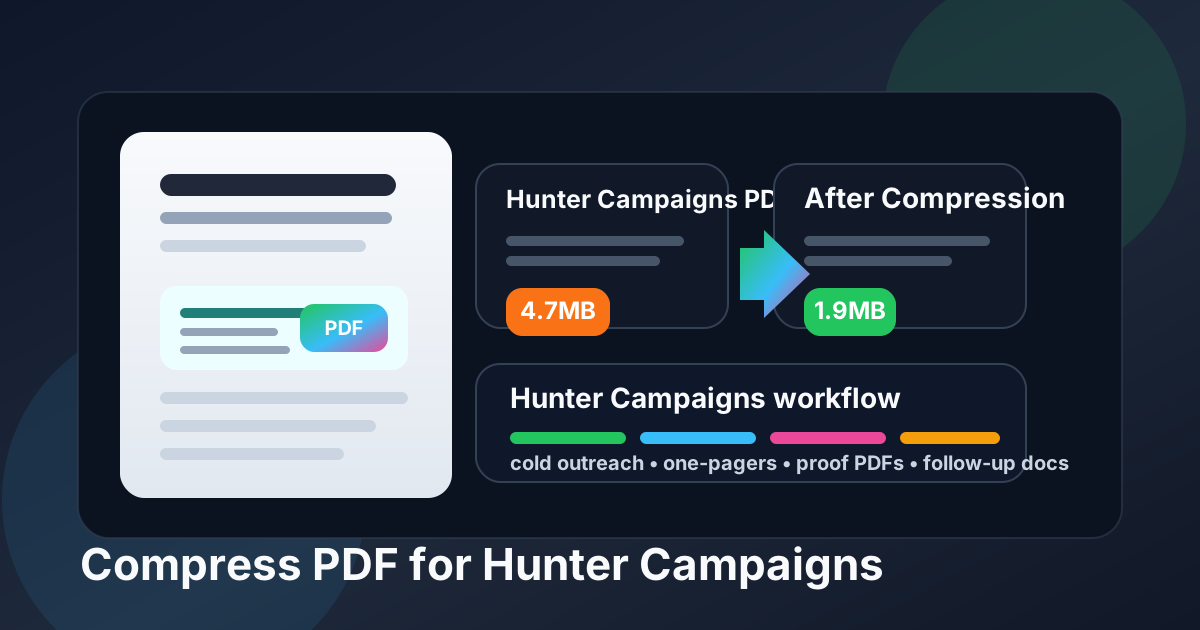
Table of contents
- Quick start: compress a Hunter Campaigns PDF in about 2 minutes
- Why Hunter Campaigns PDFs get heavy so quickly
- Where large PDFs create friction in Hunter Campaigns
- What file size should you aim for?
- Which compression level should you choose?
- Step-by-step: shrink a Hunter Campaigns PDF with LifetimePDF
- Best strategy for common Hunter Campaigns PDF types
- What if the file is still too big?
- How to keep personalization details and proof points readable
- Workflow habits that keep Hunter Campaigns PDFs lighter
- Related LifetimePDF tools and useful internal reading
- FAQ (People Also Ask)
Quick start: compress a Hunter Campaigns PDF in about 2 minutes
- Open Compress PDF and upload the exact file you plan to send, attach, or reuse in Hunter Campaigns.
- Start with Medium compression. It is usually the safest balance for one-pagers, pricing sheets, case studies, proposals, and short follow-up PDFs.
- Download the smaller copy and reopen it where the file is really used: the sequence step, the follow-up email, or the teammate handoff.
- Check the details that matter most: names, dates, pricing, screenshot labels, CTA buttons, proof points, and the smallest text on the busiest page.
- If the file is still heavier than it should be, use Extract Pages or Split PDF before you try stronger compression.
That order works because many Hunter Campaigns PDFs are not large only because of image quality. They are large because too much material got bundled into one attachment. Clean the structure first and compression usually becomes easier, safer, and more predictable.
Why Hunter Campaigns PDFs get heavy so quickly
Hunter Campaigns documents usually come from fast-moving outbound work. A short one-pager turns into a fuller leave-behind. A case study picks up extra screenshots. A proposal keeps old versions, prep notes, or a long appendix because nobody wanted to cut something that might become useful later. By the time the file is attached to an outreach step, it often carries more than the recipient actually needs right now.
The most common causes are familiar:
- oversized screenshots pasted into the source file before PDF export,
- duplicate pages or older versions left in the final attachment,
- internal prep notes or approval pages that should never reach the prospect copy,
- scanned pages with dark borders, empty margins, or unnecessary background texture,
- appendix material that matters later but not in the current outreach step.
Compression helps, but it works best after the document itself is focused. A cleaner file compresses better and creates less friction when somebody opens it from an email.
Where large PDFs create friction in Hunter Campaigns
A heavy file does not always ruin a cold email. But it does create the kind of small resistance that weakens momentum:
- the attachment takes longer to load during a quick first skim,
- the document feels bloated compared with the short, direct tone of the outreach,
- the recipient gets more pages than they need at that stage,
- teammates keep reusing oversized versions because nobody cleaned the source file,
- last-minute aggressive compression makes proof details harder to trust.
Hunter Campaigns is strongest when the next useful action feels easy. A lighter PDF supports that rhythm. It keeps the file easier to open without making it feel flimsy.
What file size should you aim for?
For most Hunter Campaigns workflows, these targets are practical rather than absolute:
- Under 2MB: ideal for one-pagers, short case studies, concise proof docs, and simple cold outreach attachments.
- 2MB to 5MB: reasonable for longer proposals, screenshot-heavy decks, and multi-page follow-up packets that still need visual clarity.
- Above 5MB: worth reviewing before you send, because there is usually extra weight you can remove more cleanly than by crushing image quality.
These are not rigid rules. A clean 3MB proposal is better than a blurry 900KB one. The right target is the smallest file that still feels calm and readable on both desktop and mobile.
Which compression level should you choose?
Medium compression is the best starting point for most Hunter Campaigns PDFs. It usually removes enough weight to reduce friction while keeping screenshots, pricing, proof details, signatures, and CTA sections easy to read.
A simple rule of thumb:
- Low compression when the PDF already looks efficient and you only need a modest size drop.
- Medium compression for the default Hunter Campaigns workflow and most prospect-facing attachments.
- High compression only when the document is still too heavy after cleanup and the visuals are not the main trust element.
If the file contains tiny screenshot labels, pricing notes, personalized examples, side comments, or busy audit visuals, stronger compression is usually the wrong first move. Remove waste first. Then test the lighter copy in the real workflow before squeezing harder.
Step-by-step: shrink a Hunter Campaigns PDF with LifetimePDF
- Start with the final prospect-facing PDF. Do not upload the internal working version if it still includes draft pages, comments, or appendix material.
- Open Compress PDF. Keep the workflow simple and start with the exact file you really plan to send.
- Choose Medium compression first. This is usually the safest quality-to-size balance for Hunter Campaigns attachments.
- Download the smaller copy. Save it with a clear filename so nobody confuses it with the heavier original.
- Test the real workflow. Reopen the file in the same Hunter Campaigns sequence step, follow-up email, or handoff point where it will actually be used.
- Inspect the details that matter. Review the busiest page, the smallest text, screenshots, dates, names, prices, and CTA sections.
- Clean structure if needed. If the PDF is still too heavy, remove duplicate pages, split the appendix, or extract only the pages the prospect truly needs.
That process is reliable because it treats compression as part of document hygiene, not a magic fix. Smaller files work best when the document itself is already focused.
Best strategy for common Hunter Campaigns PDF types
One-pagers and intro assets
These should usually land under 2MB without much drama. Medium compression is often enough. If the file is still heavy, look for oversized screenshots, repeated graphics, or a cover page that adds weight without adding value.
Case studies and proof documents
These often carry charts, outcome screenshots, short testimonials, and result summaries. The risk is making proof harder to trust. Keep the pages that tell the story cleanly, compress on Medium, and inspect the densest evidence page before you approve the smaller copy.
Proposals and pricing sheets
These are trust-heavy files. If totals, assumptions, timeline notes, or next-step details go fuzzy, the size win is not worth it. Compress lightly first, then remove outdated versions or internal prep pages if the file is still carrying too much weight.
Follow-up packets
Follow-up PDFs get bloated fast because they collect multiple useful assets into one file. Ask whether the recipient needs the whole packet right now. In many cases, sending the core document first and splitting a detailed appendix into a separate file creates a cleaner Hunter Campaigns experience.
What if the file is still too big?
If Medium compression does not get you close enough, do not jump straight to maximum compression. Clean the file in smarter ways first:
- use Extract Pages to keep only the prospect-facing section,
- use Delete Pages to remove outdated versions or duplicate exports,
- use Split PDF when one file is doing too many jobs,
- use Crop PDF to trim wasted scan borders,
- re-export a cleaner original if the source document itself is overloaded with giant images.
Compression works best after structure improves. If you try to fix a messy file only by shrinking it harder, readability usually pays the price.
How to keep personalization details and proof points readable
Before you replace the original attachment, check the things prospects actually notice:
- pricing, totals, package notes, and timeline details,
- names, dates, reply instructions, and next-step deadlines,
- screenshots, dashboards, audit callouts, and labels inside them,
- signature blocks, approval areas, and CTA buttons,
- the busiest page in the file, not only the cleanest one.
If any of those feel fuzzy, uncertain, or tiring to zoom into, keep the lighter setting or clean the file another way. Compression should remove waste, not confidence.
Workflow habits that keep Hunter Campaigns PDFs lighter
A few habits stop attachment bloat from returning:
- send the final prospect-facing PDF, not the internal prep packet,
- keep archived versions and appendix material separate when they do not belong in the live sequence,
- replace duplicate exports instead of stacking similar files for the same campaign,
- use cleaner digital originals instead of rescanning a document that already exists electronically,
- check mobile readability before deciding the PDF is truly done.
Those habits matter because Hunter Campaigns works best when the next useful file opens fast. Cleaner document discipline saves time long after the email is sent.
Related LifetimePDF tools and useful internal reading
If Hunter Campaigns is only one part of your outreach stack, these tools and guides pair well with this workflow:
- Compress PDF for the main size-reduction step.
- Extract Pages when only the core document should stay attached.
- Delete Pages to remove outdated versions or repeated exports.
- Split PDF to separate the live file from backup material.
- Crop PDF to trim wasted scan borders.
- PDF Metadata Editor for cleaner document properties.
- Compress PDF for Snov.io.
- Compress PDF for SalesBlink.
- Compress PDF for QuickMail.
- Compress PDF for Reply.io.
- Compress PDF for Smartlead.
- Lifetime access if PDF cleanup is a repeat part of your outreach workflow.
Bottom line: for most Hunter Campaigns PDFs, start with Medium compression, test the real workflow, and trim page weight before you use stronger compression.
FAQ (People Also Ask)
How do I compress a PDF for Hunter Campaigns?
Upload the final PDF to a compressor, start with Medium compression, download the smaller copy, and test it in the real Hunter Campaigns workflow before replacing the original. Medium is usually the safest first pass because it lowers file size without making screenshots, proof details, pricing, signatures, or CTA sections harder to trust.
What file size should I aim for in Hunter Campaigns?
For one-pagers, short case studies, and simple outreach attachments, under 2MB is a strong target. Longer proposals, screenshot-heavy decks, and multi-page follow-up packets usually work best around 2MB to 5MB as long as the smallest useful detail still reads clearly.
Will PDF compression blur screenshots or personalization details in Hunter Campaigns emails?
It can if you compress too aggressively. That is why Medium compression is the best place to start. Always check names, dates, screenshot labels, proof details, CTA sections, and the busiest page before you keep the smaller file.
Should I split a large PDF instead of compressing it harder?
Often, yes. If one PDF combines the prospect-facing document with internal notes, old versions, approvals, or a long appendix, splitting it usually creates a cleaner Hunter Campaigns workflow than forcing the whole bundle through aggressive compression.
Which LifetimePDF tools pair best with Hunter Campaigns?
Compress PDF is the main starting point. Extract Pages, Delete Pages, Split PDF, Crop PDF, PDF Metadata Editor, and OCR PDF are especially useful when you want smaller, cleaner Hunter Campaigns attachments without carrying extra pages, scan waste, hidden metadata, or image-only text forward.
Published by LifetimePDF - Pay once. Use forever.