Compress PDF for HubSpot: Keep Quotes, Proposals, and CRM Attachments Small Without Losing the Details
To compress a PDF for HubSpot, upload the file to LifetimePDF's Compress PDF tool, start with Medium compression, and keep the smaller copy only if pricing tables, screenshots, signatures, logos, and small-text details still read cleanly.
For most HubSpot workflows, under 2MB is a strong target for quotes, one-pagers, and contracts, while proposals, case studies, brochures, and image-heavier sales PDFs usually work best around 2MB to 5MB.
HubSpot attachments get bloated in very ordinary ways. A clean quote becomes a proposal packet. A proposal picks up screenshots, a case study, a pricing appendix, and a signed agreement. The file is not necessarily more useful. It is often just heavier to send, slower to open, and more annoying for the next person to review on a laptop or phone. Good compression fixes that without making the document feel cheap.
Fastest path: use LifetimePDF's Compress PDF tool at Medium, then trim appendices, delete repeated pages, or split bulky support material only if the file is still heavier than the recipient actually needs.
Need the short version? Jump to Quick start: compress a HubSpot PDF in about 2 minutes.
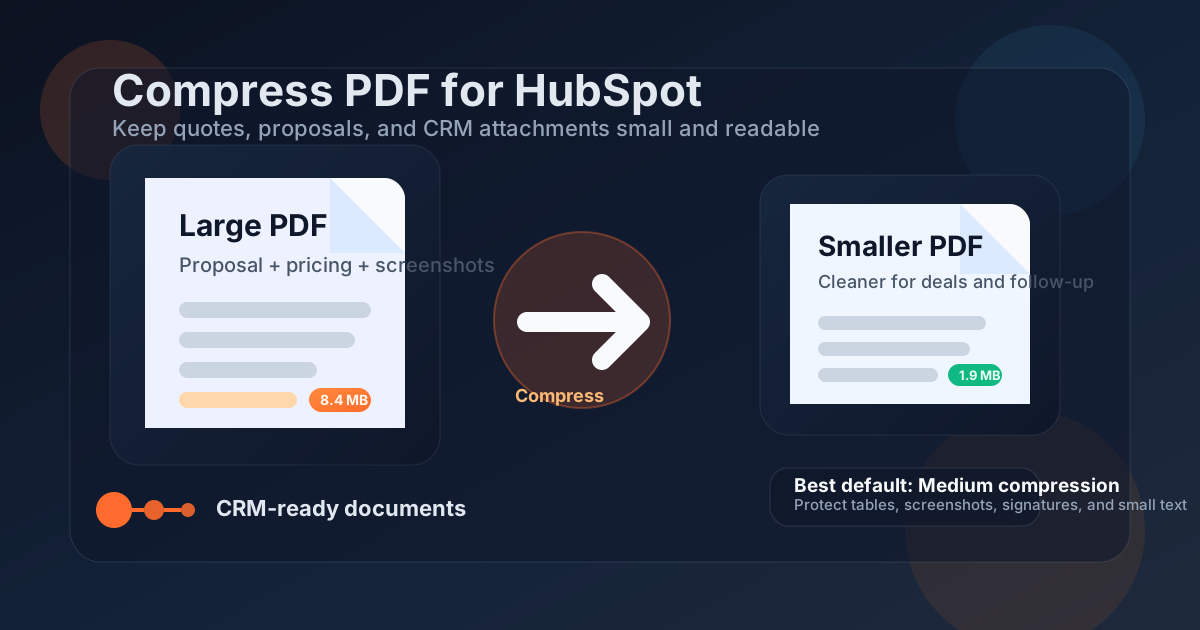
Table of contents
- Quick start: compress a HubSpot PDF in about 2 minutes
- Why smaller PDFs help in HubSpot workflows
- What size should a HubSpot PDF be?
- Which compression level should you choose?
- Step-by-step: shrink a PDF with LifetimePDF
- Best approach for common HubSpot document types
- What to do if the PDF is still too large
- How to keep client-facing details readable
- Workflow habits that prevent PDF bloat
- Related LifetimePDF tools and useful reading
- FAQ (People Also Ask)
Quick start: compress a HubSpot PDF in about 2 minutes
If your real goal is simply make this HubSpot PDF smaller so it is easier to send, attach, or reopen later, this workflow is usually enough:
- Start with the quote, proposal, one-pager, contract, case study, pricing sheet, onboarding packet, or signed attachment you actually plan to keep.
- Open Compress PDF.
- Choose Medium compression first.
- Download the smaller file and compare the size reduction.
- Check the fragile details once: price columns, screenshots, signatures, logos, footnotes, comparison tables, and the smallest readable text.
- If the packet is still bulky, use Delete Pages, Extract Pages, Split PDF, or Crop PDF before trying stronger compression.
Why smaller PDFs help in HubSpot workflows
HubSpot sits close to real handoff moments. The PDF is often not background admin clutter. It may be the quote a rep sends after a call, the proposal attached to a deal, the one-pager a prospect opens on mobile, the signed agreement added to a record, or the case study used in follow-up. A bloated file slows all of that down.
Smaller PDFs reduce friction at each step. They send more smoothly, open faster on ordinary laptops, and make it easier for the next person to focus on the message instead of wrestling with the attachment. The useful goal is not the tiniest document possible. It is the smallest document that still preserves the proof and polish.
Why compression usually pays off
- Faster sending: useful when quotes, proposals, and follow-up attachments need to move quickly.
- Smoother mobile review: many prospects and customers first open a PDF on a phone.
- Cleaner internal handoffs: lighter files are easier for teammates to review, forward, and reuse.
- Less scan waste: signed pages and rescanned paperwork often carry shadows, empty borders, and repeated pages.
- Better downstream cleanup: leaner PDFs are easier to sign, split, crop, redact, and archive once the file is under control.
What size should a HubSpot PDF be?
There is no single magic number for every HubSpot workflow, but practical target ranges keep you from compressing harder than necessary:
| Document type | Good target range | What to protect |
|---|---|---|
| Quotes, pricing sheets, one-pagers | About 0.5MB to 2MB | Price columns, product names, dates, totals, and offer details |
| Proposals, contracts, and onboarding PDFs | About 1MB to 3MB | Signatures, small legal text, screenshots, tables, and clause references |
| Case studies, brochures, and image-heavier sales collateral | About 2MB to 5MB | Charts, logos, screenshots, visual callouts, and readability on mobile |
| Anything above 5MB | Usually needs cleanup first | At that size, duplicate pages, oversized images, empty scan borders, or unnecessary appendix content are often the real problem |
The right size depends on what the next reader actually needs. If the file exists to prove pricing, value, terms, identity, approval, or customer fit, protect those details first. The goal is not to chase a dramatic percentage reduction. The goal is to make routine CRM documents easier to work with.
Which compression level should you choose?
Problems usually start when someone jumps straight to the strongest setting because the file looks larger than they want. That is how you turn clean pricing tables, crisp screenshots, and readable signatures into soft visual mush. In most HubSpot workflows, a measured approach works better:
- Low compression: useful when the PDF is already fairly clean and only needs a light trim without touching dense small text or polished design too much.
- Medium compression: the best default for most quotes, proposals, contracts, and mixed sales PDFs because it usually cuts size without hurting trust.
- High compression: use this only after removing duplicate pages, cropping scan waste, or splitting an oversized packet.
Step-by-step: shrink a PDF with LifetimePDF
- Save the final working copy first. Use the file you actually plan to send or attach, not an early export with pages you already know nobody needs.
- Open Compress PDF.
- Upload the file. This could be a quote, proposal, one-pager, signed agreement, pricing sheet, case study, brochure, or onboarding packet.
- Start with Medium compression. It is usually the safest first pass for customer-facing PDFs.
- Download the smaller result. Check the new size and decide whether it already feels easier to handle.
- Preview the weak spots. Look at price tables, screenshots, signatures, logos, footnotes, dates, and any fine-print legal text.
- Use structure fixes only if needed. If the file is still too heavy, remove duplicate pages, extract only the useful section, split the appendix, or crop scan waste before trying a stronger setting.
Useful sequence: compress first, then clean the packet structure. In sales and CRM workflows, the oversized file is often carrying too much baggage, not too little compression.
Best approach for common HubSpot document types
1. Quotes and pricing sheets
These usually compress well because the most important information is text-based. Medium compression is often enough. The risk is not losing decorative polish. The risk is softening totals, discount rows, line items, or product names just enough to slow the next review.
2. Proposals and one-pagers
These files often mix text, branding, screenshots, and a few visual blocks. Compress them moderately, then zoom in on the sections that actually carry the decision: comparison tables, deliverables, pricing, screenshots, and small notes.
3. Contracts and signed documents
Contracts need slightly more caution because signatures, initials, clause references, and fine print all matter. Compress once, then check every signature area and the smallest legal text. If the packet includes exhibits or repeated drafts, the smarter move is often to split or trim the file instead of compressing the whole thing harder.
4. Case studies and brochures
These are more likely to be image-heavy. Compression can still help a lot, but the visual story matters. If the PDF relies on screenshots, charts, or customer-facing design, make sure those elements still feel sharp enough to support the message.
5. Onboarding packets and scan-heavy attachments
These files often grow because multiple teams keep appending the next piece of proof. The smartest fix is often structural, not visual. Remove duplicate exports, split appendices, crop dead scan borders, and keep the main packet easy to follow.
What to do if the PDF is still too large
When a HubSpot PDF stays heavy after one reasonable compression pass, the issue is often packaging rather than image density. Try these in order:
- Delete repeated or blank pages. This solves more than people expect.
- Extract only the pages the next reader needs. A focused packet is better than a 30-page archive dump when the workflow only needs a clean summary.
- Split the appendix. Keep the main proposal or contract in one PDF and the backup material in another.
- Crop empty borders and background. Scan waste adds size without adding value.
- Rebuild the source export. Sometimes a cleaner original PDF beats harsher compression every time.
- Only then try stronger compression. By that point, the file is usually leaner already.
How to keep client-facing details readable
Before you keep the compressed copy, check the weakest details on the page rather than the strongest ones. Big headlines almost always survive. The useful details are what quietly fail.
- Pricing tables: make sure the smallest rows, decimals, and package names still read cleanly.
- Screenshots: check labels, callouts, product UI text, and small visual proof points.
- Signatures and initials: confirm they still look intentional rather than smudged.
- Logos and brand visuals: they do not need print perfection, but they should not look broken.
- Legal copy and footnotes: zoom in on fine print, clause references, and terms.
- Dates and names: especially on approvals, onboarding paperwork, and signed attachments.
A 20-second review saves more time than rebuilding the packet later because someone could not read the exact line they needed.
Workflow habits that prevent PDF bloat
- Export once from the cleanest source you have. Reprinting and rescanning usually adds weight without adding value.
- Keep the main attachment focused. Archive the appendix separately if nobody needs it for the next step.
- Trim before you merge. It is easier to keep one packet clean than to repair a giant combined PDF later.
- Review on mobile once if the file is likely to be opened from a phone.
- Keep one clean final version. Stacked exports and repeated revisions quietly create bulk nobody asked for.
Related LifetimePDF tools and useful reading
HubSpot document prep often turns into a few follow-on tasks. These tools usually pair well with compression:
- Compress PDF for the first size-reduction pass.
- Extract Pages when only part of the packet needs to travel.
- Delete Pages to remove duplicate or blank support pages.
- Split PDF when one packet is doing two jobs at once.
- Crop PDF to trim dead scan borders.
- Sign PDF when the file needs approval after cleanup.
If you want adjacent reading, these guides fit the same workflow family: Compress PDF for HubSpot: Share Smaller Sales PDFs, Quotes, and Attachments Faster, Compress PDF for HubSpot Without Monthly Fees, Compress PDF for Salesforce, and Compress PDF for PandaDoc Without Monthly Fees.
Bottom line: if the HubSpot PDF is too large, start with Medium compression, protect the details people actually need to read, and clean the packet structure before you force the file any harder.
FAQ (People Also Ask)
How do I compress a PDF for HubSpot?
Upload the HubSpot-ready PDF to a PDF compressor, start with Medium compression, and keep the smaller copy only after checking pricing tables, screenshots, signatures, logos, and small legal text. For most HubSpot workflows, Medium is the safest starting point because it reduces file size without making customer-facing details feel rough.
What file size should I aim for with HubSpot PDFs?
Text-heavy quotes, one-pagers, pricing sheets, and contracts often work well under 2MB. Proposals, case studies, brochures, and image-heavier sales PDFs usually land better around 2MB to 5MB as long as the smallest useful details remain clear.
Will compression make pricing tables or screenshots blurry?
It can if you compress too aggressively. That is why Medium compression is usually the best first move. Always review pricing tables, screenshots, logos, signatures, and small legal text before you keep the smaller file.
Should I compress before or after merging HubSpot documents?
If you already know the final packet, merge first and then compress the finished PDF once. If the file is oversized because it includes duplicate pages, stale appendices, or support material the recipient does not really need yet, trim or split those sections first.
What if my HubSpot PDF is still too large after compression?
Delete duplicate pages, crop scan borders, split one oversized packet into a main file and appendix, or rebuild the source export more cleanly. In many HubSpot workflows, better packet structure helps more than stronger compression.