Compress PDF for Heap: Keep Product Analytics Reports, Journey Reviews, and Stakeholder PDFs Small Without Losing the Details
To compress a PDF for Heap, export the finished report, upload it to LifetimePDF's Compress PDF tool, start with Medium compression, and keep the smaller copy only if event names, path steps, chart labels, screenshots, and notes still look clean.
For most Heap PDFs, under 2MB is a strong target for short dashboard snapshots and weekly updates, while multi-page journey reviews, product analytics decks, retention summaries, and stakeholder packets usually work best around 2MB to 5MB after light cleanup.
Heap exports often become the portable version of work that normally lives inside a live product analytics workspace. They get attached to planning docs, emailed to leadership, shared with growth teams, uploaded into project trackers, or archived so someone can revisit the story later without opening the dashboard. Smaller PDFs help because they remove friction from that handoff. The real goal is not to crush every file to the smallest number possible. It is to make the export light enough to move comfortably while keeping the labels, screenshots, chart context, and written takeaways easy to trust.
Fastest path: run the Heap export through LifetimePDF's Compress PDF tool on Medium, then use Extract Pages, Split PDF, or Delete Pages only if the packet still includes appendix sections, repeated screenshots, or backup material the next reader does not actually need.
Need the short version? Jump to Quick start: compress a Heap PDF in under 2 minutes.
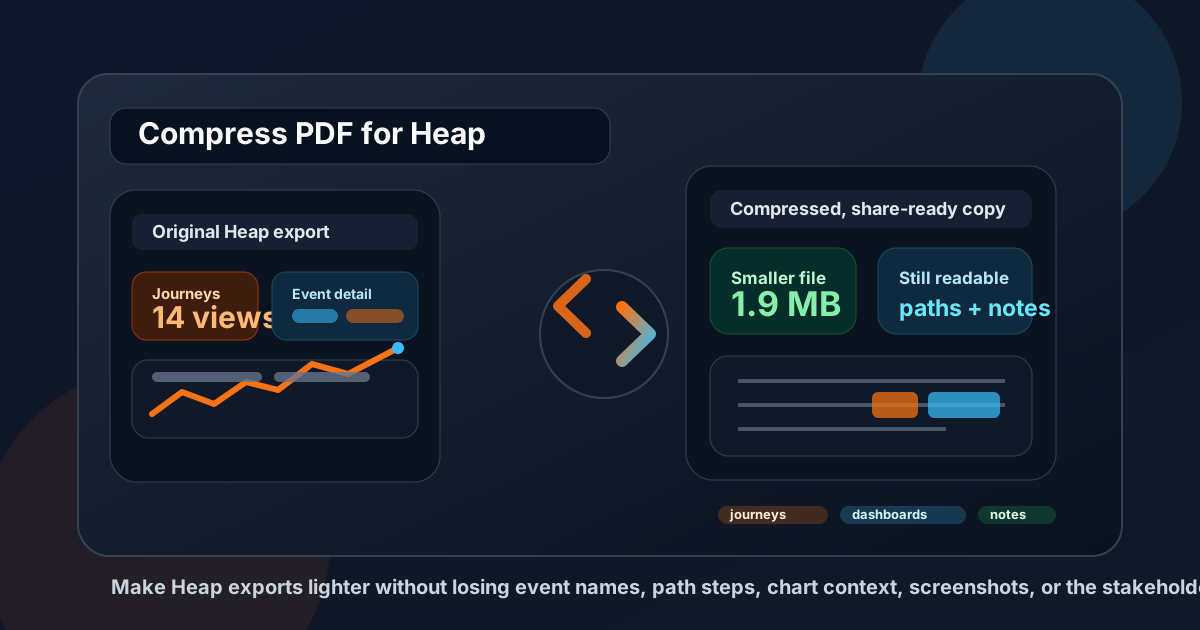
Table of contents
- Quick start: compress a Heap PDF in under 2 minutes
- Why Heap PDFs get heavy so quickly
- What file size should you aim for?
- Which compression level should you choose?
- Step-by-step: shrink a Heap PDF with LifetimePDF
- Best strategy for common Heap PDF types
- What if the PDF is still too large?
- How to protect charts, tables, and path readability
- Workflow habits that keep Heap exports cleaner
- Related LifetimePDF tools and useful reading
- FAQ (People Also Ask)
Quick start: compress a Heap PDF in under 2 minutes
If your real goal is simply make this Heap PDF smaller so it is easier to send, review, or archive, this workflow is usually enough:
- Open Compress PDF.
- Upload the dashboard snapshot, journey review, funnel report, retention summary, activation readout, or stakeholder packet you actually plan to send.
- Choose Medium compression first.
- Download the smaller result and compare the new size with the original.
- Open it once and check the weak spots: event names, path steps, conversion notes, date ranges, chart legends, screenshots, and narrow tables.
- If the PDF is still bulkier than it should be, extract only the needed pages, split the appendix, or delete repeated support pages before trying stronger compression.
Why Heap PDFs get heavy so quickly
Heap PDFs get large for the same reason many analytics exports do: one document quietly starts trying to serve too many audiences. The same file becomes an executive summary, a growth-team review, a product meeting handout, an experiment appendix, and an archive copy all at once. Compression helps, but the deeper size problem is often that the PDF is carrying more screenshots, extra pages, and backup context than the next reader actually needs.
Heap workflows also mix different kinds of visual weight. Journey charts, path screenshots, retention tables, funnel summaries, event definitions, comments, and pasted slides do not all compress the same way. A clean chart-heavy PDF behaves differently from a packet full of full-width screenshots or repeated appendix pages. That is why the best result usually comes from balanced compression plus a little cleanup instead of simply pushing the strongest compression setting.
What usually adds weight
- Screenshot-heavy exports: large interface captures and annotations add bulk fast.
- Overloaded review packs: one PDF tries to satisfy product, growth, leadership, and archived-reference needs at the same time.
- Appendix sprawl: backup views, event dictionaries, or older comparison pages stay attached by default.
- Repeated summary slides: duplicated covers, repeated charts, or version-history pages quietly add size without adding value.
- Wide margins and empty space: exported screenshots often contain more unused canvas than readers actually need.
What file size should you aim for?
There is no single perfect size for every Heap export, but a few practical ranges keep you from compressing harder than necessary:
| Heap PDF type | Good target | Why that range works |
|---|---|---|
| Short dashboard snapshot or KPI recap | Under 2MB | Easy to attach, upload, and reopen during quick reviews without losing basic labels or notes. |
| Journey review or funnel summary | 2MB to 4MB | Usually enough room to preserve step labels, screenshots, event names, and written interpretation. |
| Retention analysis or stakeholder deck | 2MB to 5MB | More realistic when the PDF includes several charts, screenshots, and commentary pages. |
| Appendix-heavy board or cross-team packet | As small as practical after splitting | Often better handled as two PDFs instead of one aggressively compressed file. |
If the file already opens quickly and sends cleanly, stop there. The right target is the smallest size that still leaves the report comfortable to read. Chasing another few hundred kilobytes is rarely worth it if the result makes charts or screenshots harder to trust.
Which compression level should you choose?
The safest starting point for most Heap exports is Medium compression. It usually cuts enough weight to make the PDF easier to move around without flattening small labels or softening screenshots too much.
| Compression level | Best for | Main trade-off |
|---|---|---|
| Low | Already-light PDFs that just need a small size reduction | Preserves quality well, but may not shrink enough for larger stakeholder packs. |
| Medium | Most Heap journey reviews, funnel reports, and retention exports | Best balance between smaller size and readable analytics detail. |
| High | Oversized drafts or screenshot-heavy files after cleanup | Can make event names, path labels, and chart legends noticeably softer. |
Step-by-step: shrink a Heap PDF with LifetimePDF
- Export only the report you really plan to share. If you already know the audience only needs the summary pages, do not start with the biggest possible packet.
- Open Compress PDF.
- Upload the file and choose Medium compression. This is usually the safest first pass for Heap charts, journey screenshots, and stakeholder notes.
- Download the smaller result. Compare file size first so you know whether the compression pass actually solved the problem.
- Review the details that carry trust. Check event names, path steps, date ranges, chart legends, segment labels, screenshots, and written takeaways.
- Clean the file only if needed. If the PDF is still too large, use Extract Pages, Delete Pages, or Split PDF before trying stronger compression.
That last step matters. In many Heap workflows, a smaller PDF comes more from sharing fewer pages than from squeezing the entire report harder.
Best strategy for common Heap PDF types
| Common file | Best first move | What to double-check after compression |
|---|---|---|
| Journey review | Use Medium compression, then crop empty margins if screenshots feel oversized. | Path steps, annotations, highlighted flows, and any callout text on screenshots. |
| Funnel report | Start with Medium and keep the file focused on the final summary pages. | Stage names, conversion percentages, comparison dates, and short interpretation notes. |
| Retention recap | Compress first, then split appendix material if the file is still heavy. | Cohort labels, axes, tiny percentages, trend legends, and footnotes. |
| Activation or experiment readout | Delete duplicate slides or backup screenshots before trying High compression. | Before-and-after comparisons, event definitions, screenshots, and summary conclusions. |
| Stakeholder or board packet | Make a shorter main PDF and move backup pages into a second file. | Executive summary readability, chart captions, and the pages readers actually discuss live. |
What if the PDF is still too large?
If Medium compression helps but not enough, the next move is usually less PDF, not harder compression. That means trimming the file so the smaller copy matches the real sharing job.
- Extract the summary pages if the recipient does not need the full appendix.
- Split one long packet into two files when leadership and analysts need different levels of detail.
- Delete duplicate or outdated pages from revision-heavy exports.
- Crop oversized margins on screenshot-heavy pages so the PDF carries less empty space.
- Keep backup detail separate instead of compressing it into the same file as the main story.
How to protect charts, tables, and path readability
A compressed Heap PDF only works if someone can still trust what they are seeing. That means reviewing the spots that tend to break first:
- Event names: long labels are often the first thing to get annoying.
- Path steps and journey nodes: small labels can soften fast when screenshots shrink.
- Date ranges and segment names: tiny text on chart headers matters more than people think.
- Legend colors and axes: if the chart feels harder to interpret, the file is not ready yet.
- Written takeaways: notes, recommendations, and experiment conclusions should still feel easy to scan.
One quick open-and-check pass is usually enough. If the report makes you zoom immediately, the file is probably too compressed for a smooth stakeholder handoff.
Workflow habits that keep Heap exports cleaner
The best compression result often starts before you ever upload the PDF:
- Export only the views the next audience actually needs.
- Keep a short share-ready version separate from the deep-dive appendix.
- Remove duplicate screenshots or old recap pages before exporting the final packet.
- Use cropping when screenshots include a lot of unused interface area.
- Standardize a lighter stakeholder template so every review does not start from an oversized master pack.
Those habits matter because PDF size is usually a workflow problem before it becomes a compression problem. The cleaner the packet starts, the easier it is to make it small without losing clarity.
Related LifetimePDF tools and useful reading
If you work with Heap exports regularly, these LifetimePDF pages pair well with the exact-match guide:
- Compress PDF for the first size-reduction pass.
- Extract Pages when only the summary pages need to be shared.
- Split PDF when one report is trying to serve two different audiences.
- Delete Pages for repeated appendix or outdated revision pages.
- Crop PDF for screenshot-heavy reports with wasted margins.
- Compress PDF for Heap Without Monthly Fees for the pay-once angle.
- Compress PDF for Heap: Share Smaller Product Analytics Reports, Dashboard Exports, and Client PDFs Faster for the broader companion guide.
- Compress PDF for Mixpanel and Compress PDF for Amplitude if you are comparing similar product analytics workflows.
FAQ (People Also Ask)
How do I compress a PDF for Heap?
Export the Heap PDF, upload it to a compressor, start with Medium compression, and keep the smaller copy only if event names, path steps, chart labels, screenshots, and notes still read clearly. Medium compression is usually the safest first pass because it lowers file size without making product analytics review annoying.
What file size should I aim for with Heap PDFs?
Under 2MB is a strong target for short dashboard snapshots, KPI recaps, and quick stakeholder updates. Multi-page journey reviews, retention analyses, funnel breakdowns, and product analytics decks usually work best around 2MB to 5MB as long as the smallest useful details still read clearly.
Will compression make Heap charts or path reports blurry?
It can if you compress too aggressively. That is why Medium compression is usually the best starting point. Always review event names, path steps, date ranges, chart legends, segment labels, screenshots, and written takeaways before you replace the original export.
Should I split a large Heap report instead of compressing it harder?
Often, yes. If one PDF combines executive summaries, journey reviews, retention detail, funnel screenshots, and appendix pages for different audiences, splitting it usually works better than forcing stronger compression across the whole packet.
Which LifetimePDF tools pair best with Heap workflows?
Compress PDF is the main starting point. Split PDF, Extract Pages, Delete Pages, Crop PDF, Merge PDF, and the related Heap guides on LifetimePDF are especially useful when you want smaller, cleaner, stakeholder-ready analytics packets.
Ready to shrink the file? Start with the main Heap export, use Medium compression, and only clean up extra pages if the PDF is still heavier than the workflow needs.