Compress PDF for Google Business Profile Without Monthly Fees: Shrink GBP Reports, Review Snapshots, and Client PDFs Without Another Subscription
If you need to compress a PDF for Google Business Profile without monthly fees, export or print the report as PDF, use a pay-once PDF compressor, start with Medium compression, and keep the smaller file only if screenshots, review details, and profile notes still read clearly.
For most GBP workflows, that is enough to shrink location reports, review snapshots, and client-ready PDFs without adding one more recurring software bill.
This is one of those tasks that should stay simple. You already did the real work by collecting the report, organizing the evidence, and deciding what the next person needs to see. Making the PDF easier to email, upload, or archive should feel like a finishing step, not a reason to start another subscription. If the goal is a smaller Google Business Profile PDF that still looks trustworthy when someone checks screenshots, ratings, comments, charts, and action notes, a pay-once workflow is usually the cleaner answer.
Fastest path: export the GBP report as a PDF, run it through LifetimePDF's Compress PDF tool at Medium, then split or extract pages only if the file still feels heavier than the next reader needs.
In a hurry? Jump to Quick start: compress a Google Business Profile PDF in under two minutes.
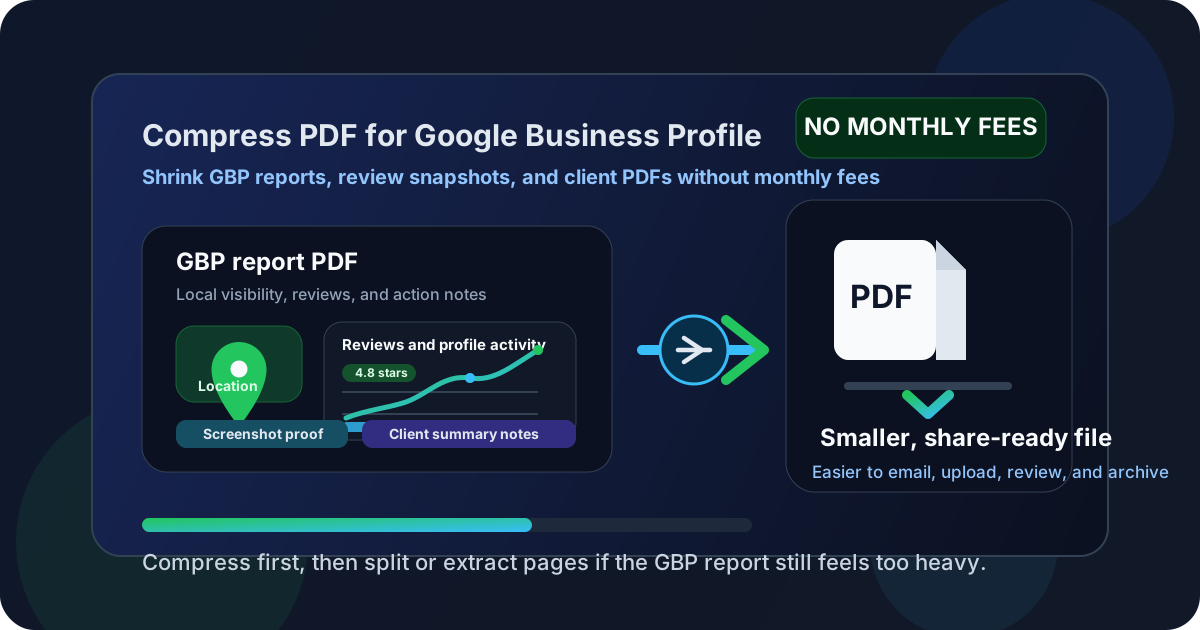
Table of contents
- Quick start: compress a Google Business Profile PDF in under two minutes
- Why "without monthly fees" matters here
- Why smaller PDFs help in Google Business Profile workflows
- What file size should you aim for?
- Which compression level should you choose?
- Step-by-step: shrink the file with LifetimePDF
- Common Google Business Profile PDFs that benefit from compression
- What to do if the PDF is still too large
- How to keep screenshots, ratings, and notes readable
- Workflow habits that reduce PDF bloat
- Related LifetimePDF tools and internal links
- FAQ (People Also Ask)
Quick start: compress a Google Business Profile PDF in under two minutes
If your real goal is simply make this Google Business Profile PDF smaller so it is easier to send, open, and save, use this workflow:
- Create the PDF copy first by exporting the report, printing the review you want to share, or saving the final client update as PDF.
- Open Compress PDF.
- Upload the GBP report, review snapshot, multi-location summary, screenshot pack, or client-ready PDF you want to shrink.
- Choose Medium compression first.
- Download the smaller file and check the new size.
- Preview the sections that matter most: location names, star ratings, review screenshots, charts, dates, comments, and action notes.
- If the file is still heavier than you want, use Extract Pages, Split PDF, or Delete Pages instead of repeatedly crushing the full report.
Why "without monthly fees" matters here
People usually search for this kind of keyword because the job keeps repeating while the problem itself stays small. A local SEO consultant, agency, in-house marketer, or small business owner may already be paying for reporting tools, review platforms, storage, local SEO software, and client communication software. Paying one more monthly fee just to make a PDF smaller often feels disproportionate.
That is why the wording matters. The need is practical. Somebody wants to email a lighter Google Business Profile update, upload a smaller report to a client portal, archive a tidier monthly pack, or hand off a clean PDF to the next teammate. A pay-once workflow fits that reality better than subscription sprawl.
There is also a trust issue. Plenty of "free" PDF tools stay free right up until the moment you try to download the result. Then the last click turns into an account wall, a trial expiration, or a payment screen. When the underlying task takes two minutes, that friction feels bigger than the work.
Plain-English version: if you already pay for the systems that generate your reports, you probably do not want another recurring bill just to make those PDFs easier to send.
Why smaller PDFs help in Google Business Profile workflows
Google Business Profile PDFs are usually created for handoff, not for deep editing. A client needs a review summary. A location manager wants a before-and-after snapshot. A business owner needs a quick performance update. An agency account manager wants a lightweight monthly recap that can be forwarded without explanation. In all of those situations, file size turns into a usability problem.
Heavy PDFs open more slowly, are more annoying to upload, and are easier for busy readers to postpone. The extra weight often comes from screenshot-heavy pages, multi-location appendices, repeated profile views, or one oversized PDF trying to serve every audience at once. Good compression is not about chasing the smallest possible number. It is about trimming waste while keeping the parts people still rely on, such as ratings, screenshots, map context, review text, trend charts, and next steps.
Why compression usually helps
- Faster sharing: smaller PDFs are easier to email, upload to portals, and attach to internal updates.
- Smoother reviews: lighter files open faster during calls, handoffs, and approval rounds.
- Cleaner archives: monthly location reporting stays easier to store and revisit when files are not bloated by duplicated screenshots and long appendices.
- Better client experience: stakeholders are more likely to open a tidy file than a bulky attachment.
- Less rework: compressing once is usually easier than rebuilding and resending a report after someone says the original file was awkwardly large.
What file size should you aim for?
There is no single perfect number because a one-location review snapshot behaves differently from a multi-location reporting pack with screenshots, annotations, and appendix pages. Still, a few practical ranges make the decision easier.
| Use case | Recommended target | Why it works |
|---|---|---|
| Single-location updates, short review snapshots, and concise owner recaps | < 2MB | Usually small enough for easy email sharing and quick review on any device. |
| Most monthly Google Business Profile summaries, review packs, and client PDFs | 2MB to 5MB | Often the best balance between convenience and readability. |
| Screenshot-heavy multi-location reports, proof appendices, and long white-label decks | 5MB+ | Usually a sign the file should be split, trimmed, or simplified before broader sharing. |
The right target also depends on who will open the file. A strategist may tolerate a larger appendix. Clients, owners, and store managers usually benefit more from a tighter summary. If the reader only needs the main signal and a few proof points, a smaller, more focused PDF is often better than a heavily compressed version of the entire export.
Which compression level should you choose?
Most Google Business Profile PDFs should start with Medium compression. It usually removes enough weight to matter without immediately softening small labels, review screenshots, date ranges, map thumbnails, or note sections.
| Compression level | Best for | Watch out for |
|---|---|---|
| Low | Already-clean PDFs that only need a modest size reduction | You may not save enough space to solve the real sharing problem. |
| Medium | Most GBP review exports, location summaries, and client-ready monthly reports | Still review smaller labels, screenshot callouts, and narrow charts once. |
| High | Internal copies where size matters more than presentation polish | Review text, star ratings, screenshot evidence, and comments can get soft fast. |
If you feel tempted to push harder than Medium, pause first and ask whether the whole PDF needs to stay together. In many Google Business Profile workflows, splitting one oversized report is smarter than making every page blurrier.
Step-by-step: shrink the file with LifetimePDF
- Export the final version first. Create the Google Business Profile PDF you actually plan to share, not a rough draft with extra pages you already know will get cut.
- Open LifetimePDF Compress PDF.
- Upload the file. This might be a review summary, location health report, screenshot pack, monthly performance PDF, or client-facing local SEO update.
- Start at Medium. That is the safest first pass for most client-facing GBP documents.
- Download the result and check the new size. Bigger reductions are helpful only if the document still reads cleanly.
- Review the risky spots. Focus on profile screenshots, star ratings, review excerpts, location names, trend charts, date ranges, and action notes.
- If the file is still too large, clean it before re-compressing. Try Delete Pages, Split PDF, or Crop PDF before a stronger compression pass.
Common Google Business Profile PDFs that benefit from compression
Not every Google Business Profile PDF behaves the same way. Some are mostly text and short screenshots. Others get heavy because they include repeated profile captures, comment details, or separate sections for many locations. These are the most common situations where compression helps.
1. Review snapshot PDFs
These usually compress well because they mix moderate text with a few screenshots. Medium compression is often enough. Just confirm that star ratings, reviewer names, dates, and comment excerpts still read comfortably.
2. Monthly profile performance summaries
Reports with charts, screenshots, and action notes often benefit from one balanced compression pass. They still need a quick readability check because smaller labels and date ranges can soften sooner than body text.
3. Multi-location client packs
This is where file bloat shows up fastest. One document may include performance updates, review excerpts, profile screenshots, and different sections for many branches. Compression helps, but splitting by location, region, or stakeholder is often the better move.
4. Screenshot-heavy proof PDFs
Sometimes the whole point of the document is visual proof. Maybe you are showing before-and-after changes, issue resolution, or review moderation context. In those cases, readability matters even more than raw file size. Use Medium first and avoid aggressive compression unless the file is staying internal.
What to do if the PDF is still too large
If your Google Business Profile PDF is still bigger than you want after a sensible compression pass, the answer is usually less PDF, not harsher compression.
- Extract only the decision-ready pages: use Extract Pages when the reader only needs the summary, key screenshots, and next steps.
- Split bulky appendices: use Split PDF to separate the executive recap from detailed screenshot proof or multi-location sections.
- Delete duplicate or stale pages: use Delete Pages to remove repeated covers, old revisions, or screenshots that no longer help.
- Crop wasted margins: use Crop PDF when wide captures or excess white space are inflating the file for no good reason.
- Compare versions before sending: use Compare PDFs if several versions are floating around and you need to confirm the final copy.
In practice, most recipients do not need every page you can technically export. The best PDF is often the one that keeps the signal and drops the clutter.
How to keep screenshots, ratings, and notes readable
The parts most likely to suffer during compression are the parts readers still care about most. That is why a quick review matters.
- Check star ratings and small labels: tiny symbols and location-specific labels can get fuzzy first.
- Zoom in on charts and date ranges: especially if the PDF includes thin lines, small legends, or tight monthly comparisons.
- Review screenshot annotations: arrows, highlights, and callouts can lose clarity faster than plain text.
- Confirm review excerpts still read naturally: if the point of the PDF is proof or sentiment, the words still need to be easy to read.
- Open the file on a normal screen: not just a large monitor. If it works on an average laptop, it is usually in a safe range.
Workflow habits that reduce PDF bloat
A lot of Google Business Profile file-size problems start before compression. Better reporting habits usually create smaller, cleaner PDFs from the beginning.
- Build audience-specific versions: owners, location managers, and strategists do not all need the same appendix.
- Keep proof separate from the story: send the main summary first and attach detailed screenshot evidence only when needed.
- Avoid repeated profile captures: one useful screenshot beats five nearly identical ones.
- Trim old revision pages before export: do not rely on compression to clean up report sprawl you already know is unnecessary.
- Clean metadata before external delivery: use PDF Metadata Editor when a polished client-facing copy matters.
- Merge with intention: if you need one package, use Merge PDF to combine only the pages that actually belong together.
The less clutter you export, the less you have to fix later. Compression works best as the final polish, not the main cleanup strategy.
Related LifetimePDF tools and internal links
If Google Business Profile reporting is part of your regular workflow, these tools pair well with compression:
- Compress PDF - shrink review packs, location summaries, and client PDFs before sharing
- Split PDF - break one oversized report into smaller audience-specific files
- Extract Pages - isolate only the pages a client, owner, or manager actually needs
- Delete Pages - remove outdated revisions, repeated screenshots, or appendix clutter
- Crop PDF - trim white space and awkward screenshot margins
- Merge PDF - combine only the supporting pages that belong in one package
- PDF Metadata Editor - clean hidden file details before client delivery
- Compare PDFs - useful when several report versions exist and you want to confirm the final copy
Need the no-subscription route? Use Compress PDF for the first pass, then clean up the report with split, extract, delete, or crop tools only when the file still feels heavier than it should.
FAQ (People Also Ask)
How do I compress a PDF for Google Business Profile without monthly fees?
Export the Google Business Profile report or screenshot pack as a PDF, upload it to LifetimePDF, start with Medium compression, and review the smaller copy before sharing it. If the file is still bulky, split or extract the pages people actually need instead of over-compressing the whole document.
What file size should I aim for with Google Business Profile PDFs?
Under 2MB is a strong target for short single-location summaries, review snapshots, or owner updates. Broader multi-location packs, screenshot-heavy reports, and client review decks usually work better around 2MB to 5MB as long as the smallest important text still reads clearly.
Will compression make Google Business Profile screenshots blurry?
It can if you compress too aggressively. Medium compression is usually the safest first step because it reduces file size without immediately damaging profile screenshots, review details, star ratings, charts, and action notes.
Should I split a large Google Business Profile PDF instead of compressing it harder?
Often, yes. If one PDF includes several locations, repeated screenshots, appendices, and different sections for different readers, splitting the file usually works better than forcing stronger compression across every page.
Which LifetimePDF tools pair best with Google Business Profile exports?
Compress PDF is the best starting point. Split PDF, Extract Pages, Delete Pages, Crop PDF, Compare PDFs, Merge PDF, and PDF Metadata Editor all help when you need smaller, cleaner, client-ready Google Business Profile PDFs.