Best Tools to Convert PDF to Word on Chromebook
The best tool to convert PDF to Word on Chromebook is usually a browser-based PDF-to-Word converter in Chrome for normal text PDFs, OCR first for scans, and Google Docs or Word on the web for cleanup after the DOCX is created.
For most people, the fastest Chromebook workflow is check whether the text is selectable → convert clean files directly in the browser → use OCR for scans → tidy the DOCX only if formatting still needs help.
That answer sounds simple, but it solves most of the Chromebook frustration people run into. A clean class handout, a scanned form from a printer, a contract from Google Drive, and a design-heavy brochure do not behave the same way once you try to turn them into editable text. The real trick is choosing the right tool for the file before you start fixing formatting that was doomed from the beginning.
Fastest practical path: start with PDF to Word in Chrome for ordinary files, switch to OCR if text is not selectable, then use Google Docs or Word on the web only for cleanup instead of forcing them to do the whole conversion job.
In a hurry? Jump to the best tool by situation or the step-by-step Chromebook workflow.
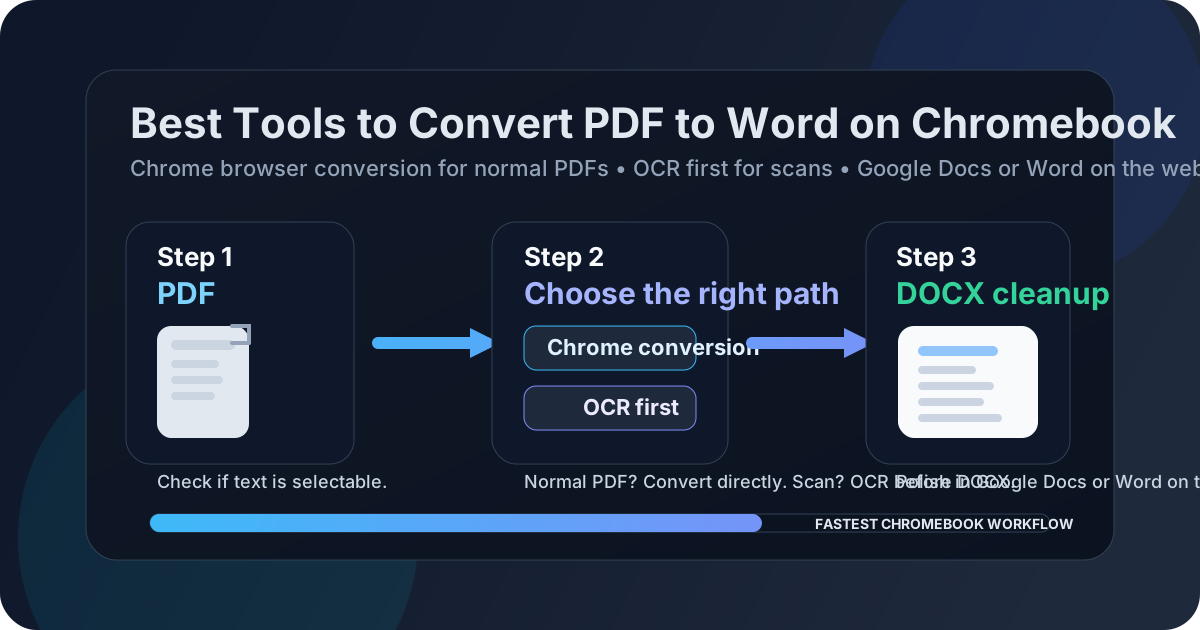
Table of contents
The short answer
If your PDF already contains selectable text, the best tool on Chromebook is usually a dedicated browser-based PDF to Word converter in Chrome. It is the quickest route to an editable DOCX and avoids the messy guesswork that comes from throwing every file straight into Google Docs.
If the file is scanned, photographed, or image-only, the best first tool is OCR. OCR is what turns a picture of text into real text, which is why it matters more than the converter itself for copier output, handwritten packets, and old paper forms.
If the DOCX already exists but spacing, bullets, tables, or headings still look rough, the best finishing tool becomes Google Docs or Word on the web for cleanup. Conversion, text recognition, and editing are related jobs, but they are not the same job.
Why Chromebook users get stuck with PDF to Word
Chromebook users usually get stuck for three reasons. First, Chrome, Google Drive, and Files make PDFs easy to preview, which tricks people into thinking previewing and converting are basically the same thing. Second, many PDFs are not clean digital documents at all. They may be scans, flattened forms, camera photos, tables, or design-heavy exports. Third, Chromebook users often try to force one tool to do every stage of the job because they want the simplest path possible.
The operating system is rarely the real problem. Chromebooks are great for browser-first workflows, which is exactly why direct conversion works well for ordinary PDFs. The friction comes from asking the wrong tool to handle the wrong kind of file. A digital report wants direct conversion. A scan wants OCR. A nearly-good DOCX wants cleanup, not a second conversion attempt.
Once you think in those categories, Chromebook becomes a very practical place to handle PDF-to-Word work. You do not need a giant desktop suite to get good results. You just need the right sequence.
Best tools by situation
1) Best overall tool for most Chromebook users: browser-based PDF to Word in Chrome
For normal text-based PDFs, the best tool is a dedicated browser workflow such as LifetimePDF PDF to Word. It handles the actual conversion directly and fits the way Chromebook is already meant to be used.
- Best for: reports, contracts, handouts, proposals, resumes, invoices, and office PDFs with selectable text
- Why it works well on Chromebook: fast in Chrome, no extra desktop install, clean DOCX output for later editing
- Less ideal for: scans, handwriting, noisy camera photos, or visually complex brochures
2) Best tool for scanned PDFs: OCR first
If the PDF came from a printer-scanner, a phone camera, or an old archive upload, a direct converter often produces a disappointing Word file because the page is basically an image. That is where OCR PDF becomes the real best tool in the workflow.
- Best for: scanned assignments, paper forms, receipts, copier packets, old manuals, and image-only PDFs
- Use it before: converting to Word, extracting text, searching, or summarizing
- Reality check: OCR quality still depends on scan clarity, page rotation, contrast, and page damage
3) Best cleanup tools after conversion: Google Docs or Word on the web
On Chromebook, cleanup usually happens in the browser too. Once the DOCX already exists, Google Docs or Microsoft Word on the web becomes the practical place to repair headings, bullets, spacing, tables, comments, and page breaks.
- Best for: final editing, cleanup, collaboration, and small formatting repairs
- Strong at: headings, list cleanup, comments, basic tables, and quick sharing
- Weakest at: replacing OCR or perfectly rebuilding every complex layout from the original PDF
4) Best helper tools for awkward files: unlock, extract, and split
Some PDFs only become easy after one small prep step. That is especially true when the file is locked, much larger than necessary, or mixes clean digital pages with ugly scanned ones.
- Locked file? Use PDF Unlock first, if you are authorized.
- Only need part of it? Use Extract Pages so you do not convert more than you need.
- Mixed clean and messy pages? Use Split PDF and handle each part properly.
Step-by-step: the best Chromebook workflow
If you want the most reliable result on Chromebook, this is the workflow that makes the most sense in real work.
Step 1: Check whether the PDF already contains real text
Open the file in Chrome or your preferred viewer and try selecting a sentence. If text highlights cleanly or search works, the file is probably ready for direct conversion. If you want a quick sanity check, see how to check if a PDF has a text layer on Chromebook.
Step 2: If text is not selectable, run OCR first
Do not force an image-only PDF through a normal converter and hope it improves. OCR is the step that turns a picture of text into something Word can actually edit. If you need help, follow this Chromebook OCR guide.
Step 3: Reduce the problem before you convert
Huge appendices, sideways pages, locked files, or mixed-quality packets create extra cleanup later. Extract the section you need, split messy pages away from clean ones, or unlock the file if you are allowed to do so.
Step 4: Convert the prepared PDF to DOCX
Once the PDF is in the right condition, run it through PDF to Word in Chrome. This is where Chromebook keeps things simple: the browser does the heavy lifting without pushing you into a desktop app you never wanted.
Step 5: Clean up the DOCX in Google Docs or Word on the web
Review headings, bullet lists, tables, page breaks, spacing, and fonts. Conversion gets you into editable form; a web editor is where you make the document presentable.
Step 6: Save the finished file clearly
Keep both the original PDF and the cleaned DOCX. If you need a final PDF later, export a fresh copy from the edited document rather than overwriting the original and losing your visual reference.
The biggest gain here is not just speed. It is predictability. Once you stop expecting one browser tab to do conversion, OCR, cleanup, and rescue work all at once, the output becomes much more consistent.
Need the shortest path? Figure out whether the PDF is clean text or a scan first, then choose the tool that matches that reality.
How to choose when formatting matters
Not every PDF-to-Word job has the same goal. Sometimes you just need editable text for a quick change. Sometimes you need tables, headings, or comments to survive with minimal repair.
| If your priority is... | Best starting move | What to expect |
|---|---|---|
| Editable text fast | Direct PDF-to-Word conversion in Chrome | Great for ordinary digital PDFs with selectable text |
| Rescuing a scanned packet | OCR before conversion | Better text recovery, but scan quality still matters |
| Keeping tables reasonably usable | Convert first, then clean up in Google Docs or Word on the web | Expect some repair even when the conversion itself is good |
| Working with only part of a big file | Extract or split pages before conversion | Less noise, less cleanup, faster output |
| Perfect visual fidelity | Reset expectations before you start | Word formats are meant for editing, not for being a pixel-perfect clone of the original PDF |
This is why the best Chromebook tool changes with the document. A worksheet, a scanned lease, a brochure, and a PDF packet from Drive should not all be treated as the same kind of file.
Common Chromebook PDF situations and the smartest move
A school handout from Google Drive needs editing
If the PDF already contains selectable text, direct conversion is usually enough. Convert it to DOCX, make the edits, and export a fresh final version only after checking the layout.
A scanned form from a printer looks terrible
Start with OCR, not conversion. If the packet includes only a few relevant pages, split or extract them first so the recognized text stays cleaner and the final DOCX is easier to review.
A PDF from Files or Downloads needs a quick revision
Save a clear working copy, convert that copy, and keep the original PDF intact. Version mix-ups are easy when the source and edited file sit in the same Chromebook folder with similar names.
A password-protected PDF blocks the whole workflow
If you are authorized, unlock it first. Trying to troubleshoot conversion before solving the access problem usually wastes time because the real issue is permission, not DOCX formatting.
Ready to convert PDF to Word on Chromebook the easy way? Start with the file type, choose the right path, and only clean the DOCX after the content is truly editable.
Best Chromebook workflow for tough files: check whether text is selectable → OCR scans if needed → convert to DOCX → clean up in a web editor → save a final reviewed copy.
FAQ
What is the best tool to convert PDF to Word on Chromebook?
For most people, the best starting point is a dedicated browser-based PDF-to-Word converter for ordinary text PDFs. If the file is scanned, OCR is the best first tool. If the DOCX already exists but needs repair, Google Docs or Word on the web becomes the best cleanup tool.
Can a Chromebook convert a scanned PDF to Word cleanly?
Yes, but usually only after OCR. A scanned PDF is often just an image of text, so direct conversion tends to produce weak output until the text has been recognized properly.
Should I use Google Docs to convert PDF to Word on Chromebook?
Google Docs can help with cleanup or quick text recovery, but it is not always the best first conversion step. A dedicated converter is usually faster for clean PDFs, and OCR is still the right move for scanned files.
What should I do before converting a difficult PDF on Chromebook?
Check whether the text is selectable, unlock the file if you are authorized, extract only the pages you need, and split mixed-quality PDFs before conversion. Those prep steps often produce a cleaner Word file and save time.
Why does formatting still need cleanup after PDF to Word conversion on Chromebook?
Because PDF preserves fixed visual layout while Word formats are editable. Tables, columns, page breaks, headers, and floating images often need a final pass even after a good conversion.
Published by LifetimePDF — Pay once. Use forever.